Holocaust and Israel
Trauma, Power, and Repetition: A Psychoanalytic Reading of Two Historical Moments

The Holocaust and the current war in Gaza are separated by time, context, and structure, yet they are often brought into the same frame when people attempt to understand how extreme violence shapes collective behavior. A psychoanalytic lens examines how trauma can persist, transform, and reappear in altered forms across generations and political structures.
During World War II, Nazi Germany under Adolf Hitler carried out the Holocaust, the systematic extermination of approximately six million Jews. This was not simply mass violence, but an ideologically driven project of total annihilation, executed through bureaucratic precision and state machinery. The scale and nature of this event embedded a profound sense of existential threat into modern Jewish identity and into the political logic surrounding the creation and defense of the State of Israel.
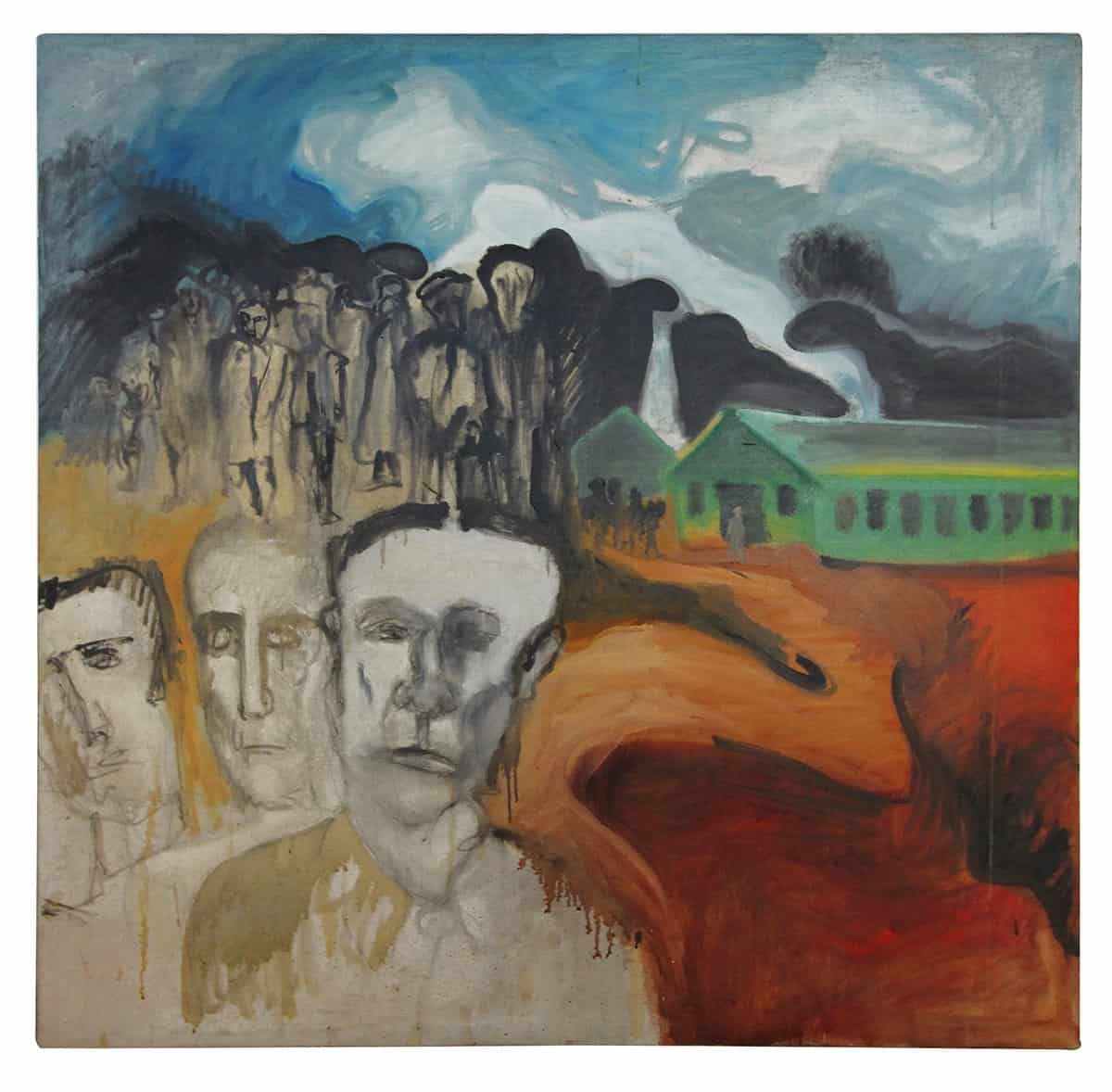
Psychoanalysis provides a framework for understanding what such trauma does beyond the immediate historical moment. Anna Freud introduced the concept of identification with the aggressor, describing how individuals or groups confronted with overwhelming threat may internalize aspects of the very force that endangers them. This is not admiration, but a defensive adaptation. By absorbing the logic of power, the victim attempts to escape the position of vulnerability. What was once external becomes internal, and eventually, actionable.
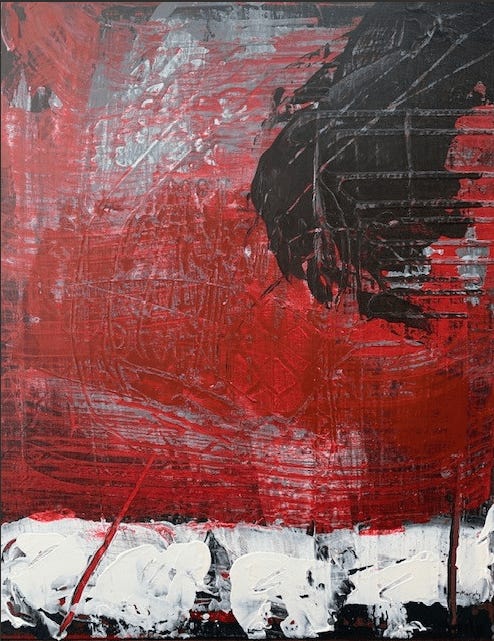
Closely related is Sigmund Freud’s concept of repetition compulsion, the tendency for unresolved trauma to be reenacted rather than simply remembered. Trauma, in this sense, is not static; it is dynamic and often reappears through behavior, institutions, and decision-making patterns. The past is not just recalled—it is, in certain conditions, reproduced.
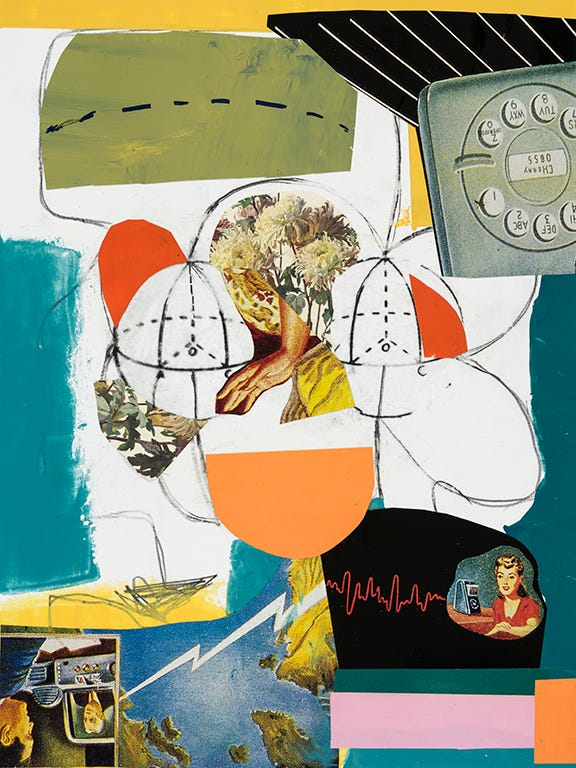
In the contemporary context of Gaza, especially following the attacks of October 7, Israeli military operations have resulted in widespread destruction, significant civilian massacre, and the large-scale displacement of the Palestinian population.
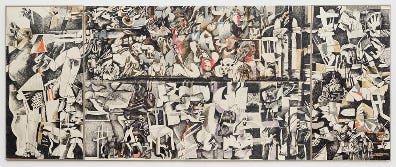
A strictly psychoanalytic reading does not attempt to adjudicate legal definitions or political legitimacy. Instead, it asks whether patterns associated with trauma can be observed in the structuring of power and response. A population historically subjected to existential annihilation may develop a security doctrine that prioritizes absolute threat neutralization. When such a doctrine operates within a context of military and technological superiority, it can produce outcomes that is overwhelming and indiscriminate force.
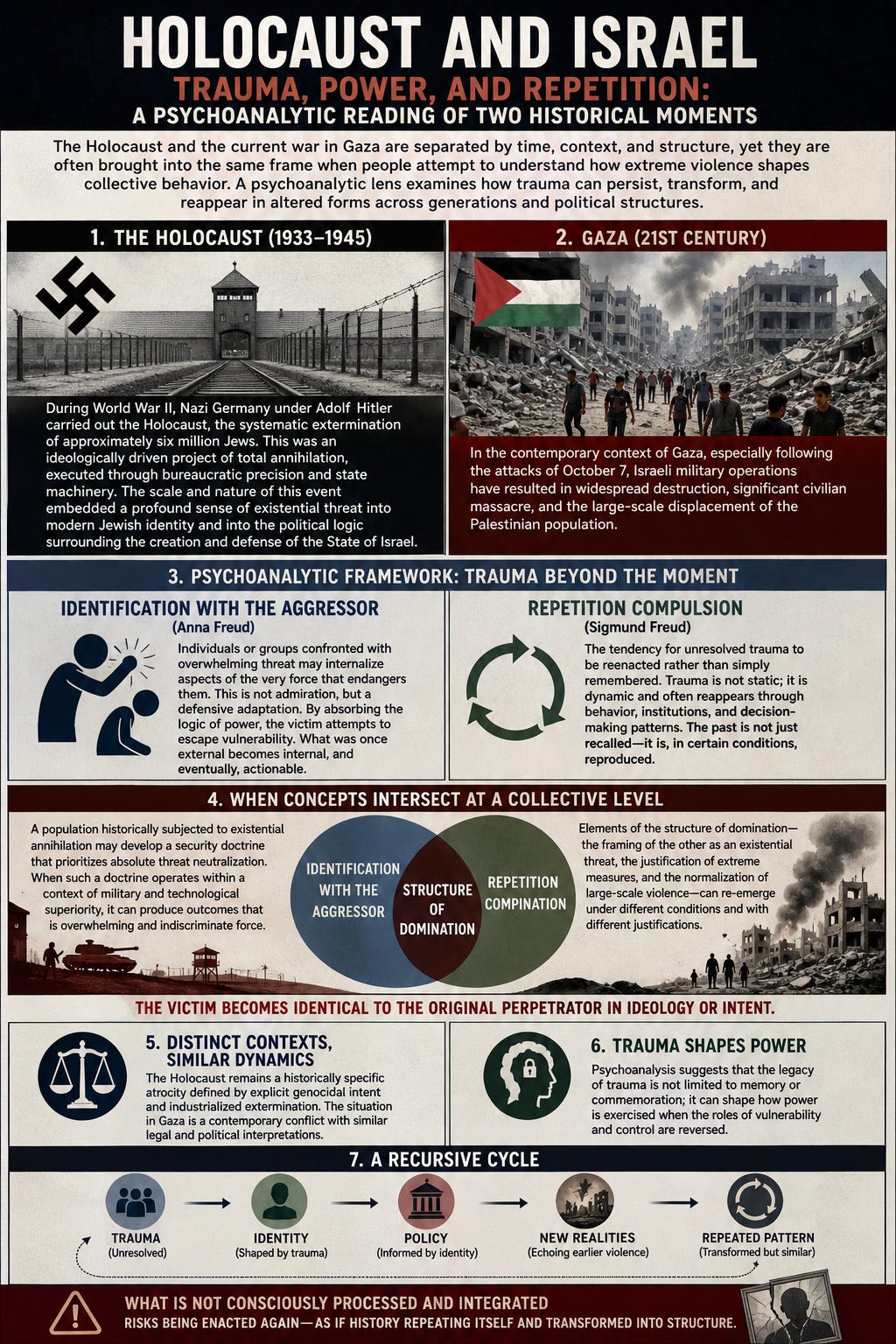
This is where the concepts of identification with the aggressor and repetition compulsion intersect at a collective level. The victim becomes identical to the original perpetrator in ideology or intent and elements of the structure of domination—the framing of the other as an existential threat, the justification of extreme measures, and the normalization of large-scale violence—can re-emerge under different conditions and with different justifications.
The Holocaust remains a historically specific atrocity defined by explicit genocidal intent and industrialized extermination. The situation in Gaza is a contemporary conflict with similar legal and political interpretations. Psychoanalysis suggests that the legacy of trauma is not limited to memory or commemoration; it can shape how power is exercised when the roles of vulnerability and control are reversed.
What emerges, then, is a claim of historical repetition in identical form, a complex pattern in which unresolved trauma reorganizes itself through the mechanisms of power. The victim replicates the past event and aspects of the psychological and structural logic underlying that event can persist and manifest in new configurations.
In this sense, the relationship between past and present is not linear but recursive. Trauma informs identity, identity informs policy, and policy shapes new realities that may echo elements of earlier violence. Psychoanalysis does not provide a moral verdict, but it does offer a caution: what is not consciously processed and integrated risks being enacted again, as if history repeating itself and transformed into structure.